An Immeasurably More Love

If you could ask God to do anything for your family, what would that be? And what would it look like if God were to do immeasurably more than anything you could imagine?

Most of us probably have a ready answer to the first question. We have a mental list of unmet longings and desires:  Heal my dad’s cancer. Let my niece get pregnant. Provide a job for my son…a husband for my daughter…a good friend for my child. Even if we’ve never spoken our prayer out loud or logged it in a journal, we know what we want.

That second question, though, is harder to process. What does “immeasurably more” look like in real life?

Ephesians 3:20 immeasurably more

The thing is, we don’t know. The Bible says God is “able to do immeasurably more than all we ask or imagine” (Ephesians 3:20), and that’s kind of the point:  We can’t imagine how much God can—and will—do. Even Bible people found themselves taken aback by the “plus plus” of his power.

Think about Zechariah and Elizabeth, the couple Luke describes as “righteous in the sight of God, observing all the Lord’s commands and decrees blamelessly.” (Luke 1:6) They were godly folk, and we have to figure they’d prayed for a child. But Elizabeth was barren. And they were, as the Bible so graciously puts it, “well along” in years. They were old.

But then came Zechariah’s moment. He was chosen, by lot, to offer incense in the temple—a once-in-a-lifetime honor for a priest. Along with offering incense, a big part of the priest’s job was to pray for the nation of Israel, including a petition for the promised Messiah. Did Zechariah sneak in a side prayer for his own family, while he was at it?

We don’t know, but it sure looks that way. The angel shows up and tells Zechariah his prayer “has been heard.” And then he drops the joy-bomb:  Elizabeth will have a son, a boy who will “make ready a people prepared for the Lord.” (Luke 1:13-17)

In other words, both prayers—the official priestly prayer for Israel’s Messiah and the secret “I-just-want-to-be-a-dad” longing of Zechariah’s heart—found their answer in a single moment.

Immeasurably more than Zechariah was expecting.

An above-and-beyond love

What about Elizabeth? Was she still praying for a baby, after so many years?

Again, we don’t know; my guess is that her prayer might have shifted in her old age. Sure, she still longed to become a mother, but based on her response when she discovers she’s pregnant—she says that God has “shown his favor and taken away my disgrace among the people”—it seems like Elizabeth’s deeper hurt might have been the ostracism she experienced. As a barren woman, she was an outsider. She didn’t belong.

Here again, God does immeasurably more:  He gives Elizabeth a baby and removes all traces of shame.

We see this pattern again and again in the gospels. For instance, when Jesus heals the anonymous woman who’d been bleeding for twelve years, he doesn’t just stop her physical suffering. He seeks her out—identifies her in the crowd—because he wants her to know that she is seen. That she is known. That she belongs in the family of God.

“Daughter,” Jesus says in Mark 5:34, “your faith has healed you. Go in peace and be freed from your suffering.”

The more I learn about God’s immeasurably more answers, the more I’m convinced that the whole point of him going above-and-beyond is that he wants us—all of us—to know how much he loves us. How much he understands us. How much he wants to remove any barrier—physical, emotional, or spiritual—that might keep us from knowing that we belong.

Last month, I was privileged to speak at The Pauline Chapel, a little jewel tucked just to the side of Colorado’s Broadmoor Hotel.

Jodie speaking at Pauline Chapel

I’d been thinking about how God reads the unspoken cries of our heart—the longings we might not even be consciously aware of, the blessings that have yet to be formed in our minds’ eye—and how he responds. I wound up sharing one of my favorite “immeasurably more” answers to prayer with the Broadmoor community. I’ll sum it up here (and if you want more details, you’ll find the whole story in Praying the Scriptures for Your Children.)

What happens when we pray

Once upon a time, I was part of a Moms in Prayer group that met weekly to pray for our children, often with prayers birthed in Scripture. One week, we focused on Ephesians 5:15-16, asking God to help our kids be “very careful how they lived—not as unwise but as wise, making the most of every opportunity.”

A few weeks later, one of the moms showed up and told us that that prayer had been answered—in a way none of us could have predicted—in the lives of two second-grade boys.

One of the boys, Eddie, was renowned for his misbehavior. Most kids gave Eddie a wide berth, lest he poke them with a pencil, pull their ponytail, or worse. But one little boy, Brandon, often went out of his way to be kind, and one day, when the teacher asked each child to write a persuasive letter to someone, Brandon picked Eddie.

When the time came to deliver the letters, the children who had written to parents or grandparents (trying to persuade them to buy a new bike or whatever) stuffed their notes in their backpacks to take home. Brandon simply dropped his on Eddie’s desk. Eddie was excited—but when he opened the letter, his face fell. He couldn’t read well enough to get past the first couple of words. Brandon asked the teacher—who just happened to be a Christian—if he could read the letter to his friend. The teacher agreed, telling him he could do it at recess.

That afternoon, the boys sat on a log under an old oak tree, oblivious to the shouts and games being played all around them. Eddie pulled the letter out of his pocket and leaned in to listen.

Dear Eddie, Brandon began. Please, please ask Jesus to come into your heart. Here are some reasons why:

  1. Jesus died on the cross for your sins.
  2. You will have eternal life.
  3. God (Jesus’ father) is maker and creator of all.
  4. You will go to heaven.
  5. You can have anything you want in heaven.
  6. I will be waiting for you.
  7. God will be waiting for you.
  8. Jesus will be waiting for you.
  9. You can do anything in heaven.

 P.S. All you have to do is bow your head right now and say, “Dear Lord, I want Jesus to come into my heart so I can have eternal life.” Amen.

Eddie sat back. “Would you, Brandon asked cautiously, “like to pray?”

“Yes,” Eddie said.

Sitting together at the edge of the playground, the two boys bowed their heads as Brandon led Eddie into the kingdom of God.

Old Oak tree

Friends, we don’t know—we can’t know—how God will answer our prayers. But we can slip our hand into his, trusting that he really is able to do immeasurably more than anything we can imagine.

And that his deepest desire is to have us turn to him, just like Eddie did, and say, “Yes.”

Heavenly Father,

You know I am concerned about ______. Please do immeasurably more than all I can ask or imagine in this situation, and help me trust you.

Amen.

Leave a Reply


Lay the track (and look for God’s power!)

Note:  Watchman Nee’s quote about how we “lay the track” is one of my favorite depictions of how we can partner with God through our prayers. This post ran earlier this week at Club31Women.com. They’ve got a brand new website filled with all sorts of encouraging goodies – check it out!
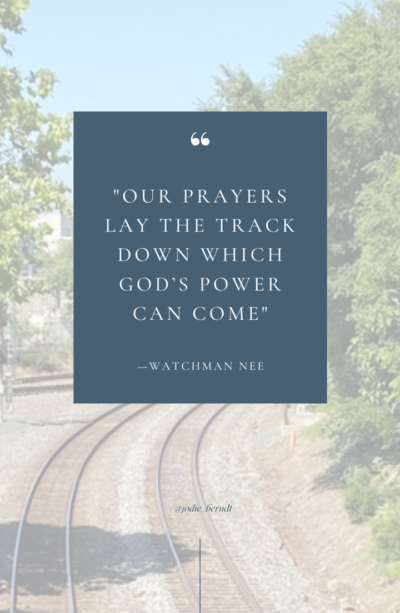
Our prayers lay the track graphic

I don’t know about you, but I spent a lot of years thinking that prayer was basically a one-way conversation in which I’d ask God for what I thought would be good and then see what happened. If my relationships or circumstances lined up with my requests, I would know that God had said yes. If not, he said no.

I didn’t begrudge God when he turned me down (I knew verses like Isaiah 55:8-9, which explain that God’s ways and his thoughts are higher than ours), but I much preferred it when I’d put in a prayer and get the answer I wanted.

I liked it when prayer worked like a vending machine.

But that’s not how Jesus sees prayer. His model for prayer is based on attachment. “If you remain in me,” he says, “and my words remain in you, ask whatever you wish and it will be done for you.” Put another way, when we stay connected to Christ and allow his words to soak into our souls and give shape to our prayers, we can pray with the full and wholehearted expectation that God will answer.

And we don’t know (we can’t know!) all the good things that God might have in store as we ground our prayers in his Word. He specializes in doing more—immeasurably more—than all we ask for or imagine.

“Immeasurably More” than we ask or imagine

One year, for example, I decided to pray 2 Peter 1:2 on behalf of one of my dearest friends and prayer partners. Suzanne (not her real name) is a gal whose zeal for life is almost unmatched—she lives big, you might say—and the word abundance in that verse caught my eye.

“May grace and peace be hers in abundance,” I prayed for my friend, again and again.

What I didn’t know—what I couldn’t have known—was that Suzanne would come up against some incredible challenges in her workplace that year, including rumors and lies that eventually led to her leaving her job. Had she not been thoroughly covered in God’s grace and peace, the fear and anxiety that tried to capture her heart during that difficult season might have succeeded. As it was, Suzanne courageously weathered a six-month-long storm. And when she came out of the darkness, she found herself in a new job—one far more fulfilling (and financially rewarding) than anything she could have imagined.

I was asking God for abundance. He was willing to provide that (and he did) but he knew my friend would need his grace and peace even more.

Be a conduit for God’s power

And here’s the thing about praying the Scriptures. We don’t do the blessing, the healing, the providing, the protecting. That’s God’s job. Our job is simply to be the conduit for his power. Our prayers release God’s provision.

Watchman Nee, a Chinese Christian writer, put it like this: “Our prayers thus lay the track down which God’s power can come. Like a mighty locomotive, his power is irresistible, but it cannot reach us without rails.”

Let’s lay the track and look for God’s power to come down in ways that go immeasurably, abundantly, beyond anything we could ask for or imagine.

❤️

Where do you long to see God’s hand at work in your life? Do you believe he is able—and willing—to give you all that you need? What would it look like for you to “lay the track” through your prayers?

The Bible says, “God is able to bless you abundantly, so that in all things at all times, having all that you need, you will abound in every good work” (2 Corinthians 9:8). Ask God for what you need today—lay some track—and then look for the locomotive of his power to come!


Leave a Reply