Experience God’s Power in Seasons of Suffering

“God has a lot on his plate—people with cancer, marriages falling apart, teenagers battling addiction—and I don’t want to be clogging the lines in case somebody with something really important is trying to get through.” I’ve heard that line, or some version of it, any number of times as I’ve talked with people about how to experience God’s power through prayer. We don’t want to “bug” God with our problems. And if our particular worry or pain has gone on for a long time, we may wonder if God has some secret reason for our suffering.

Maybe, we think, we are just supposed to endure it.

Quote about suffering with woman looking out window

Is that what the crippled woman thought when she went into the synagogue where Jesus was teaching? She’d had what the Bible calls a “disabling spirit” for 18 years. Reading her story in Luke 13:10-17, my mind swirled with questions:  Was she hopeful? Discouraged? Resigned to her situation? Did she think Jesus could heal her? Did she wonder if he cared?

And could Jesus even see her in the crowd?

He could, of course. And when he did, Jesus stopped what he was doing—he interrupted his own sermon—to call her over. “Woman,” he said, “you are freed from your disability.” (Luke 13:12)

And with that, the woman in the synagogue stood up straight and praised God.

Three Ways to Experience God’s Power

The Bible doesn’t indicate that this nameless woman ever asked to be healed; all we know is that she was “there.” She was at the synagogue where Jesus was teaching. And that, I think, is the first key to experiencing God’s transformational power:  Proximity.

We don’t have to know how to pray or what to ask for when we come to Jesus; we can simply show up. It doesn’t matter what our problem is—whether we are crippled by sickness, fear, addiction, uncertainty, or anything else. When we draw close to God, we discover a place of confidence and security. “I will praise the Lord, who counsels me,” King David wrote. “With him at my right hand, I will not be shaken.” (Psalm 16:7-8)

But proximity isn’t the only key to experiencing God’s power. We also have to be willing to listen for his voice—and respond.

When Jesus stopped teaching and called the crippled woman to come forward, do you think she was nervous? Worried about being the center of attention? Concerned about bugging Jesus, especially in front of a crowd—even as she longed to experience his power? I can imagine her feeling all of these things (particularly in a culture that did not value healthy women, let alone those who were sick or disfigured), but she didn’t let any of that hold her back.

Instead, she said responded to Christ. She said yes.

The woman positioned herself to be proximate to the Lord. She heard his call and said yes. And then, as she experienced freedom in Christ and stood upright for the first time in nearly two decades, the third step just came naturally:  She glorified God, in whose presence she found “fullness of joy.” (Psalm 16:11)

Photo of beach path with Psalm 16:11

Drawing near to God, responding to his invitation, and acknowledging his provision with praise are three keys to experiencing—and enjoying—God’s presence. But they are not, for me, the biggest takeaway from this woman’s story.

For me, the most remarkable part of the story—and the part that has been transformational for my prayer life—is that the woman could not actually see Jesus, at least not like the others could. Depending on which Bible translation you prefer, she was “bowed together,” “bent over double”, or not able to “look upwards at all.” I imagine this gal longed to behold the Lord’s face but, hunched as she was, she could glimpse only his feet.

God knows the way that you take

Job might have understood how she felt. In his suffering, he desperately wanted to see God—to know what God was doing, to plead his case, to get some sort of answer—but he could not find him. “When he is at work in the north,” Job wrote, “I do not see him; when he turns to the south, I catch no glimpse of him.

“But,” Job continued, “he knows the way that I take; when he has tested me, I will come forth as gold.” (Job 23:9-10)

I don’t know about you, but when life has me weighed down and bent over (that is to say, when it’s a struggle to look upwards at all), or when I can’t perceive God or make sense out of what he is doing, those words breathe hope into my soul:  I catch no glimpse of him. But he knows the way that I take.

Man with surfboard and dog at sunrise

God knows the way that we take. And as we consider Christ’s tenderness in hitting pause on whatever he was talking about in the synagogue to attend to a crippled woman that day, we can be equally confident that when we come before God with our needs and concerns, we are never bugging him. We are doing the very thing that delights him.

When you cannot imagine anything changing

What about you?

Can you relate to the crippled woman’s experience? Is there a “disabling” relationship or circumstance that has gone on for so long that you cannot imagine anything changing? Do you worry that you’ll be “bugging” God if you talk to him about it, especially since he has been silent for what feels like forever?

Instead of holding back, try leaning in. Draw close to God. Ask him to open your ears to his invitation—to let you hear the words he wants you to hear—and respond with whatever praise you can muster. Glorify God, as the crippled woman did, knowing that he has both the power and the desire to set you free. Here’s a short prayer that might help:

Heavenly Father,

When I am afflicted and my soul is downcast, help me find hope in this truth:  Because of your great love I am not consumed; your compassions never fail. They are new every morning. Great is your faithfulness.”  (Lamentations 3:19-23)

Amen

(Note: A version of this post appeared last month on Club31Women.com, a place where you’ll find encouragement for your faith, your family, and your home. Check out this recent post about Mary Magdalene’s Contagious Joy from my friend Nicole Zasowski. And if you’re looking for a good Bible study to do on your own or with a group this summer, click here to learn more about her just-released Daring Joy.

Daring Joy Bible study by Nicole Zasowski

Leave a Reply


Why does God allow suffering?

Robbie and I were in Colorado last week. We had a blast hiking with friends and taping a couple of shows (Focus on the Family and Rebel Parenting; I’ll keep you posted on air dates in case you want to tune in), but there were at least two other highlights on our trip.

The first was that we did not get eaten by a bear. (There’s a story there, but it will keep. Maybe next week.)

The second big plus was seeing our friends, Ann and Ty Saltzgiver. Ann’s the one on the left in this pic…

…and Ty, as you know, is our featured author this month. We spent some time catching up, the way that friends do, and as we looked back on the peaks and valleys of our lives, Ty made an interesting observation:

“If I graphed my life by the times I was experiencing more of Jesus,” he said, “and then overlaid that graph with another graph of the difficult times in my life, the lines would match up. The graphs would be nearly the same.”

That was both a sobering and an encouraging thought. I mean, given the choice, I’m pretty sure I’d “just say no” to pain…but if difficulty or suffering serves as a kind of conduit to Christ, I want to at least be open to experiencing it. Or rather, to experiencing him.

Ty writes about suffering in his book, Longing to Experience More of Jesus“Suffering, pain, trouble, and affliction happen to each one of us,” he says, but it’s never “all right.” It’s a mess. It is crushing. And it can sometimes lead to despair.

And also to questions.

A lot of people, Ty says, find it difficult to trust God in the face of their hurt, or someone else’s. “How could God allow pain and suffering, when he could so easily fix it?”
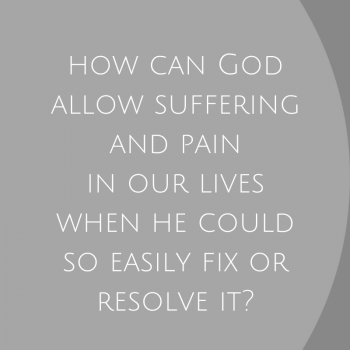
There are, of course, no easy answers. We may find it hard to read Scripture in the midst of our pain, and our prayers can seem pointless or empty. We long for God’s presence, for some reassurance, but when we feel like we need God the most, we don’t sense that he is anywhere near. Ty quotes St. Teresa of Avila, who once said to God, “It’s not at all surprising You have so few friends, considering how You treat the friends you have.”

We get that.

But we also, if we are honest, get what Ty means about graphing his life. Pain has an uncanny way of making us realize that we are not in control. And in our desperation (marked, as it often is, by a diminishing sense of independence), we may find ourselves moving closer to God.

And when we come near to him, he comes near to us, enfolding us in his embrace.

In writing about the place suffering has in our lives, Ty says he is not trying to “put a smiley face” on our pain. Rather, his aim seems to be to remind us that Jesus took on the crush of our hurt (Isaiah 53:4) and that he understands exactly how we feel. After all, he he has been there before (Hebrews 4:15-16).

Suffering is just one of 30 sometimes-challenging topics Ty covers in Longing to Experience. There’s also stuff about trusting God, going deeper in prayer, discovering your true identity, and much more. None of the chapters are long–they’re designed for use as a daily devotion–but they’re rich.

And if you’d like to win a copy…

…hop on over to Instagram (@jodie_berndt) or Facebook (@JodieBerndtWrites) and leave a comment. Or tag a friend who might want to experience more of the Lord.

Which is what I want to do.

Even (and I’m struggling to type this next part) if it means also experiencing pain. I think it was maybe Joyce Meyer who said that, having tasted the incredible blessing of God’s comfort, she found herself almost hoping she’d need it. As in, she was open to the hurt because the hug was just so much more.

Yeah. I’m not quite there yet. But…I want to be.

Heavenly Father,

You are close to the brokenhearted, you comfort us in all our troubles, and you know exactly how it feels to be despised, rejected, and familiar with pain. (Psalm 34:18, 2 Corinthians 1:4, Isaiah 53:4)

Come near to us as we come near to you. Draw us into your loving arms, and may we take refuge in your embrace. (James 4:8, Song of Songs 2:6)

Amen

❤️

P.S. This post marks the end of our September with Saltzgiver…but there’s more to come! In fact, Ty has a brand new book that’s set to release on November 1. Designed especially for families, Ready or Not (clever title, eh?) is an Advent devotional that will help prepare our hearts and our homes for Christmas. You can’t pre-order the book, but jot yourself a note to visit SaltResources.com in early November and pick up a copy for everyone on your “nice” list! 🙂


Leave a Reply