How to wake up in the morning (in the month of May-hem and beyond)

It’s here. The month of May-hem. The slower rhythms of summer are coming, but they’re not on us just yet. And if your calendar looks like mine, you may be wondering if you will even make it to June, what with all of the graduations, weddings, recitals, end-of-year parties—and let’s not forget Mother’s Day.

(Seriously. Let’s not forget Mother’s Day.)

May is not like December. December gets heralded months in advance; we’re braced for impact by mid-November. Not so with May. May can sneak up on the unwary. One minute it’s April and you’re dreaming about a spring garden–should you try pink petunias this year?—and then boom. It’s May, and you need 30 treat bags for the baseball party tomorrow.

Where do we turn for relief? I can’t answer that—not completely, anyway—but I can share something that has been life-changing for me.

(Well, potentially life-changing; I’ve only been doing this for about 12 days now. But people say it works.)

(And by “people,” I mean Andy Crouch.)

Jodie with Andy Crouch

I’ve long been a fan of Andy’s (I loved his books, Playing God and The Tech-Wise Family), and it was a huge treat to hear him speak last month at the Center for Christian Study’s 50th Anniversary Celebration in Charlottesville. (Sidebar:  If you have a kid going to the University of Virginia, or you know a student who’s headed there, click this link; the Study Center’s Move-In Day lunches are not to be missed for those looking to build Christian community from Day 1 of their college experience.)

Andy talked about a lot of things—the difference between “space” and “place”, for example, and how place kindles memory, a concept he linked to Deuteronomy 6—and I wanted more. I started poking around online and stumbled upon a short YouTube clip in which Andy talked about how to wake up in the morning—and what was clearly the wrong way to start your day.

Andy confessed that he had long held to an “ironclad rule” of checking his phone every morning, first thing. “I let the glowing rectangle tell me whatever I needed to pay attention to,” he said. Realizing that there had to be a better way, he resolved to ignore his phone and go outside as soon as he woke up, even if that meant descending several flights of stairs in a hotel on the other side of the world. What Andy discovered, as he pursued this new practice, was the gift of perspective and the ability to be who he really was:  “A very small part of a very large world, rather than what I am on the screen, which is a very large part of a very small world.”

Andy’s words resonated, and I resolved to do the same thing. I woke up and, instead of checking text messages or the weather on an app, I stepped outside with my coffee and felt the actual air. (And yes, I am grateful that it is not still February.)

It was glorious!

It was glorious the next day. And the next—getting up and going outside, leaving my phone plugged into the charger. At first, I wondered if I might miss something important (What if one of my children needs me? What if they changed the time for today’s meeting? What if I won some sort of Fabulous Prize?), but it wasn’t long before I realized that it didn’t matter. Waiting a few minutes—or half an hour—wouldn’t change anything. No matter what my phone (or my ego) might want me to believe, I am just not that essential.

Andy was right.

(Of course he was right; he wrote a whole book about putting technology in its proper place.)

Do try this at home

Today, if you drive by our house in the early morning, you might just spot me on the front porch, dressed in my favorite bathrobe or sporting some sort of workout gear. I’ll have a big cup of coffee and, more often than not, a favorite devotional book. Our dog Minnie is apt to be out there, too, sniffing the day to see what it holds.

Want to join me? The coffee isn’t required (Andy drinks tea), and you don’t need a book (Andy goes outside on his own). But if you’re like I am and you often sense God’s presence when words are around, consider starting your day with intentional praise.

Praise “changes our attitude, brings an awareness of God’s presence; defeats Satan; releases God’s power; brings a victorious perspective; provides peace; wards of the spirits of self-pity, depression, and discouragement; and produces strength in an anxious heart.” That’s according to Moms in Prayer founder Fern Nichols, quoted in Praying the Scriptures for Your Life, and honestly? I want every. single. one. of those benefits!

Right now, I’m igniting praise with the help of Ruth Myer’s classic, 31 Days of Praise:

31 Days of Praise book by Ruth Myers

The chapters are short—less than two pages—and chock full of Scripture. I often find myself reading each entry out loud (a habit I like to think Minnie appreciates).

Another time-tested favorite is Sara Hagerty’s AdoreSara knows what it’s like to wake up and not feel like giving God praise, times when grief, disappointment, or worry fills the radar screen of our lives. But, Sara says, that’s actually the best time to adore. “God does not want our polished pretenses,” she says. “He wants us to come honestly. He invites us to wrestle.”

Sara Hagerty's book, Adore - on the porch

Truth be told, you don’t need a devotional book. You can just grab your Bible and start praising your way through the psalms, kind of like Jesus did. If you do one a day, that will get you through the end of September (by which time you’ll be wishing you’d clicked that link for my favorite bathrobe).

So…here’s to deep breaths and morning calm in the month of Mayhem. You might not hear from me for awhile–hooray for Summer!—but if you live in Virginia Beach and you happen to pass by our house before 7 a.m., I hope you’ll wave!

Jodie and Minnie on the porch

Leave a Reply


The Helper knows what looks good on you

Maybe you’ve heard about the woman who looked at God and said, “So far today, I’m doing all right. I have not gossiped, lost my temper, or told any white lies. I haven’t been greedy, nasty, or selfish. I have not whined or complained or cursed—not even once! And I haven’t charged anything on my credit card or eaten any gluten.

“But…I am going to be getting out of bed in a minute, and I think I will need your help.”

Can you relate? I know I can. When it comes to right living, we all need God’s help. Particularly since obedience—doing the right thing—is linked to living in the warmth of God’s love.

“If you keep my commands,” Jesus says in John 15:10, “you will remain in my love.”

John 15:9-10

Trouble is, obedience does not come naturally. Disobedience comes naturally. “I have the desire to do what is good,” Paul writes, “but I cannot carry it out.” We’d all be doomed, when it comes to desiring and doing the right thing, except for the fact that God knew we’d need help. And he gives it to us in the form of the Holy Spirit, our Helper.

What the Helper Does

If you’ve been following along in my Facebook or Instagram stories through Lent, you know we’ve been reading Catherine Marshall’s classic book, The Helperwhich details forty different ways the Holy Spirit offers practical help in our lives. I’m linking the book in this post, but you might have to settle for a used copy; new ones are hard to come by (and cost waaaay more than the $3.95 I paid for mine, back in 1978).

The Helper (1978 edition)

The Helper does all sorts of valuable things, from reminding us what Jesus said, to equipping us with supernatural power, to guiding us in ways that save us worry and even time. He also (and this is where the ability to do the right thing comes in) gives us new desires. He doesn’t force them on us, of course, but as we entrust ourselves to the Holy Spirit’s keeping and care, he gives us (as Philippians 2:13 puts it), the “desire and the power to do what pleases him.”

I love that. Because honestly? We don’t always know what would please God. Plus, there are plenty of times when we might know the right thing to do but we just don’t want to. Or, like Paul, we might actually have the desire, but we lack the power, or the ability, to see whatever it is through to completion.

In her book, Catherine Marshall tells the story of her friend, Janet, who arrived in Washington, D.C. “deficient in taste and know-how.” Knowing that her friend needed help if she hoped to fit into the city’s sophisticated climate, Marshall connected Janet with a style maven who took her on, waiving the customary fee for her service, and ordered up a beautiful three-piece British tweed suit—something that the newcomer could feel confident wearing in almost any setting.

(Stick with me here. I know a three-piece suit—British or otherwise—might not be a “must have” today, but as a high-schooler in the 1970s who owned one made of royal blue polyester, I would have given anything to have some tweeds of my own.)

As Marshall tells the story, the suit arrived and Janet burst into tears. It was ridiculously expensive—and she wasn’t even sure she liked it! But then, as she wore it, a strange thing happened. She began to love the outfit, and her own taste started to change. “The purchase turned out to be one of the mainstays of Janet’s wardrobe for eight years,” Marshall writes. “The tweeds were not worn out even then.”

God knows what we should wear

Here’s the takeaway:  When we submit ourselves to the Holy Spirit (just as Janet submitted her will to that of the big-city stylist), we allow him to go to work in our lives. He transforms us, as Romans 12:2 puts it, renewing our minds—changing the way we think—so we can know God’s will, which is good and pleasing and perfect.

And then, somewhere along the way, it hits us:  Like a professional stylist, God knows better than we do what looks good on us. And when the Holy Spirit tells us what to wear—to “put on the new self, created to be like God in true righteousness and holiness”—we can trust that we will love the result. The Helper has impeccable taste.
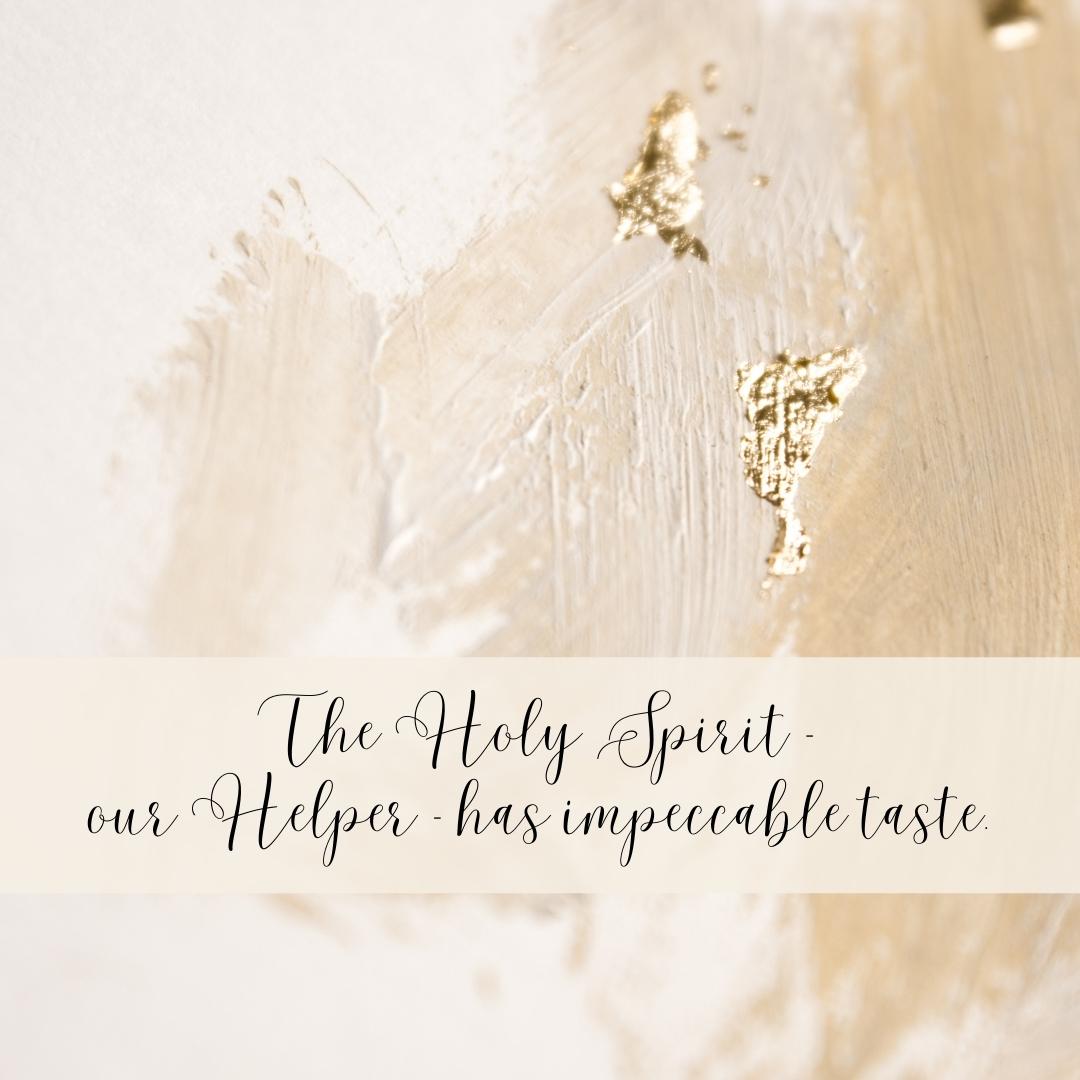
The Holy Spirit, our Helper, has impeccable taste

❤️

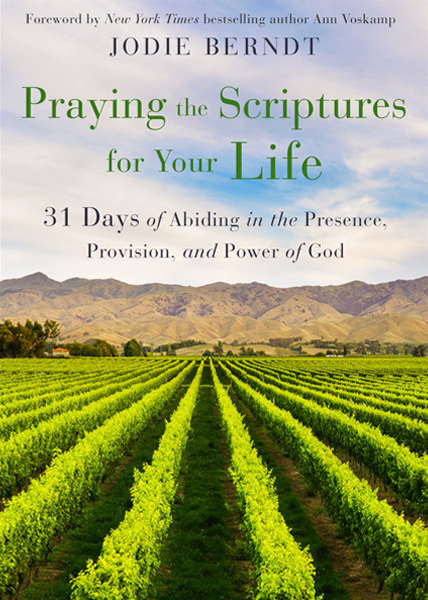
I shared the story of Janet and the professional stylist in my book, Praying the Scriptures for Your LifeIf you’d like to spend a few more minutes thinking through how the Holy Spirit can work to give you the desire and the power to do what pleases God, here is a brief excerpt from the “Reflect” section at the end of that chapter, along with a few prayers you can pray:

  • God’s commands are always designed for our benefit; they are motivated by love. Likewise, our obedience is born out of relationship, not obligation. Our connection to Christ creates our desire to obey—and it is through obedience that we abide in Christ’s love.
  • Still, though, obedience can be hard. Don’t be afraid to ask the Holy Spirit for help, knowing that your humility acts as a magnet for God’s grace. And remember: God will never give you a command that he doesn’t also give you the power to fulfill. The same power that raised Christ from the dead is at work in your life today.
  • Take a few moments to reflect on what that resurrection power can accomplish in your life. Dry, dead places can become fertile ground; sin’s chains can be broken; radiance can replace shame. Ask God to open your eyes to the beauty of his commands as you surrender yourself to his keeping, trusting the Holy Spirit to give you both the desire and the power to do what pleases God.

Heavenly Father…

Work in me to will and to act to fulfill your good purpose. (Philippians 2:13)

Create in me a clean heart. Restore the joy of my salvation and make me willing to obey you. (Psalm 51:10-12 NLT)

Don’t let me be arrogant and stiff-necked, refusing to obey your commands. May I listen to you, knowing that you are gracious and compassionate towards me, slow to anger and abounding in love. (Nehemiah 9:16-17)


Leave a Reply